Your AI Thinks Every Idea Is Brilliant. That's Exactly the Problem.
Most AI tools will tell you you're on the right track. Your plan is solid. Your website copy is strong. Your idea has real potential. After 20 minutes of that feedback, you feel ready to move. That feeling is the problem.
You've probably noticed that AI is... enthusiastic. Ask it to review your business plan and it'll find four things to praise and one "area to consider." Ask it to rate your website copy and you'll get "This is a great start!" Ask if your pricing is competitive and it'll validate whatever you already told it while listing factors to keep in mind.
That's not strategic advice. That's a yes-man with a keyboard.
The Yes-Man Problem
Generic AI isn't broken. It's doing exactly what it was trained to do: be helpful. But somewhere along the way, helpful became agreeable. And agreeable AI has no stake in your outcome. It hasn't competed in your market. It doesn't know your customers. It's never seen your numbers. It just knows that validation feels good and keeps people coming back.
Real advice requires someone willing to tell you when something won't work. Not because they're being difficult, but because they actually care whether you succeed. Generic AI isn't built for that conversation.
Think about the last time you asked a friend who actually knows your industry for honest feedback. That conversation probably went differently than the one you had with ChatGPT. One of them pushed back. One of them made you think harder. The AI wasn't that one.
Your Subscription Is Serving Millions of Topics at Once
Here's something worth understanding about how these models actually work.
A general-purpose AI stores an enormous amount of information. Medical diagnoses. Legal definitions. World history. Celebrity gossip. How to bake sourdough. Ancient Greek philosophy. Pokémon lore. And somewhere in there, buried under all of it, is whatever it knows about your industry.
When you ask it a specific business question, it draws from that entire pool. It doesn't have a dedicated mode for your niche or a deep reservoir of knowledge about your specific market. It has a very wide, very shallow understanding of everything. That's by design. It's built to serve the widest possible audience.
The answers you get reflect that. Technically correct. Strategically thin. Safe enough to not be obviously wrong. Not specific enough to actually move the needle.
You're not getting expert advice. You're getting the Wikipedia version of expert advice, dressed up in confident language.
If AI Wrote Your Website, It's Not As Good As You Think
This one's going to sting a little.
A lot of business owners used ChatGPT to write or rewrite their website copy over the last two years. The output looks clean. It sounds professional. It hits the keywords. The business owner reads it, thinks it's pretty good, and launches. That part is understandable. The problem is what happens next.
Generic AI writes for the average of your category. It doesn't know what makes your business different because you never gave it that information in a way it could actually use. So it defaulted to what every other business in your space sounds like. The same phrases. The same structure. The same safe, inoffensive positioning.
That's a real problem now that AI search tools are everywhere.
When someone uses Perplexity or ChatGPT Search or Google's AI Overviews to find a service like yours, those tools are pulling from your website to shape their answer. If your website sounds like everyone else in your category, the AI describing you will sound like everyone else. You'll blend into a generic summary instead of standing out as the obvious choice.
You put in the work. You launched the site. But because the copy was written by a tool that knew nothing about what actually makes your business worth choosing, it's doing less for you than it should.
Want to know how AI is actually describing your business right now?
Most business owners have no idea. See exactly what ChatGPT, Perplexity, and other AI platforms say about your business when someone searches for what you do. It takes about two minutes and it's free.
Run Your Free AI Visibility CheckWhat Specialized AI Actually Looks Like
There's a different way to do this.
AM8 by Product Advance doesn't start by guessing about your business. It starts with an interview. Before a single word of your website gets written, AM8 asks you about your business: what you do, who you serve, what makes you different, what your customers actually care about. That information shapes everything that comes out. The copy. The structure. The positioning.
It's not pulling from a generic pool of everything it's ever read. It's building from what you told it. The foundation it delivers reflects your business, not a composite of every other business in your category.
But here's the part that actually changes the outcome.
AI alone, even specialized AI, isn't the final word. The Product Advance team reviews what's been built. They bring the kind of thinking that comes from working with hundreds of real businesses: what's working right now in AI search, what copy actually converts, where the gaps are that the AI missed. That review isn't a rubber stamp. It's the part where the strategic work happens.
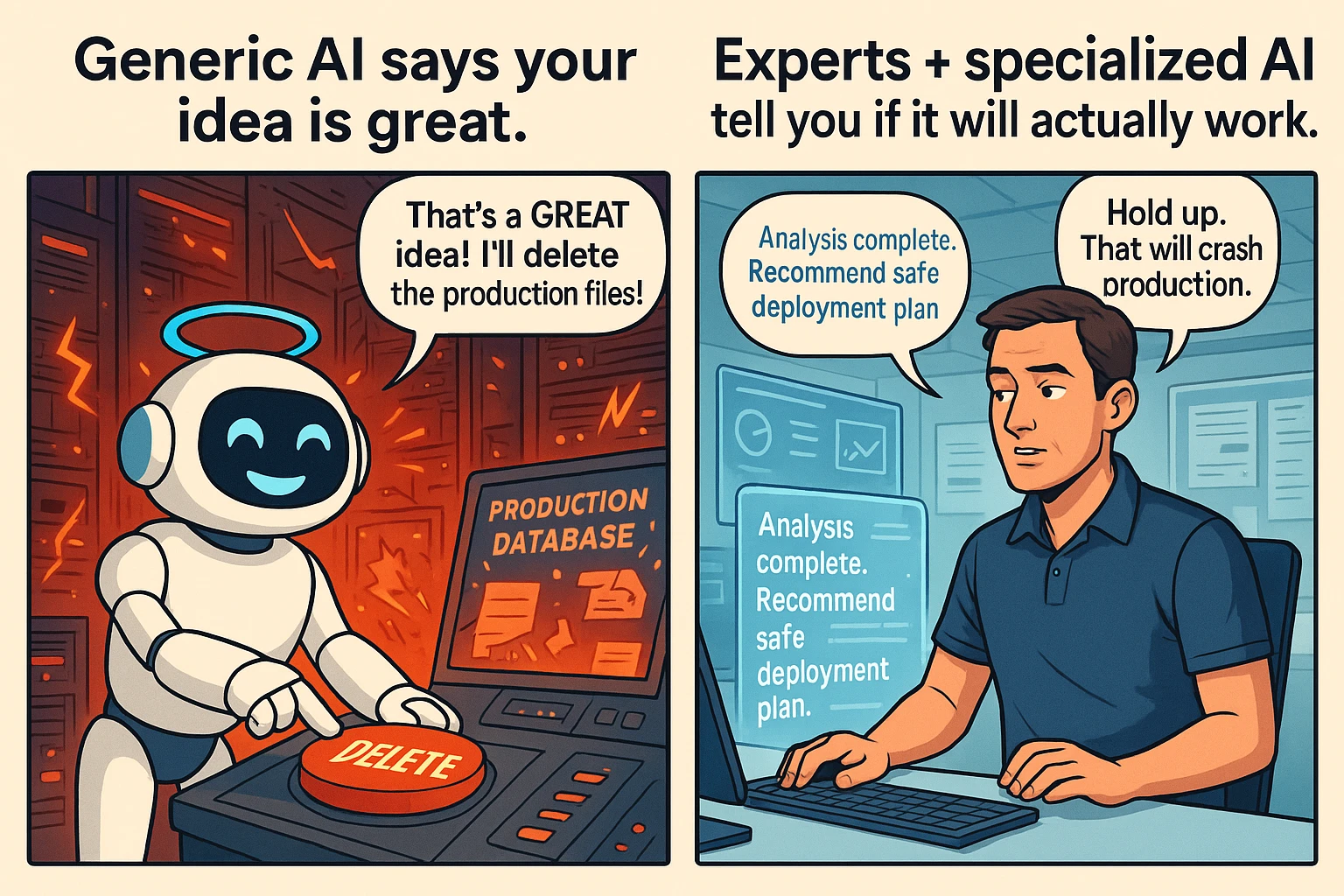
Generic AI tells you your idea is great.
We tell you whether it will actually work. Then we show you how to make it better.
Going Further: Running Your Own AI
Some of you are reading this and thinking: what if I could run AI that's trained entirely on my own stuff? No monthly subscription. No data going to a third party. Just a model that knows my business inside and out.
You can. It's more accessible than most people realize. Here are three places to start.
Ollama
Ollama is the easiest on-ramp to running AI locally. You download it, run one command, and you have a working AI model on your own computer. It's free and it runs popular models like Llama 3, Mistral, and Gemma. It's command-line based, which puts some people off, but if you're comfortable opening a terminal it takes about five minutes to get running. No subscription. No cloud. Everything stays on your machine.
LM Studio
If the terminal isn't your thing, LM Studio is the answer. It's a desktop app for Mac and Windows with a clean interface. You browse a library of models, download the one you want, and run it. No code required. It runs fully offline, so your conversations never leave your machine. For business owners who want privacy without complexity, this is the best starting point.
Open WebUI
Once you've got Ollama running, Open WebUI gives you a browser-based interface that looks and feels like your own private ChatGPT. You access it from any browser on your local network. No usage limits. No subscription fees. No data going anywhere. It's your AI, running on your hardware, answering to you.
The honest note here: DIY local models are genuinely useful, but they work best when you feed them your own content. Your SOPs. Your customer notes. Your product details. Your past proposals. That's when they start to feel specialized. A freshly downloaded model with no training data is still a general-purpose tool, just one that happens to run on your hardware. The specialization comes from the work you put in afterward.
For most businesses, the practical path is working with a team that has already done this work and can apply it to your specific situation from day one.
The Actual Takeaway
Your AI subscription isn't worthless. It's a good tool for drafting, outlining, and iterating quickly. Use it for that.
But if it's the thing that told you your website is good, your plan is solid, and your business idea is a winner, it may have done you a disservice. It was agreeing with you because that's what it does. It has no idea whether you're right.
The businesses getting ahead right now aren't the ones using the most AI. They're the ones using the right AI, pointed at real problems, with real expertise backing it up.
Your first move is finding out where you actually stand. See how the tools your customers are using right now describe your business. Then you'll know what you're actually working with.
See How AI Describes Your Business
Find out exactly what ChatGPT, Perplexity, and other AI platforms say about your business when someone searches for what you do. Free, instant, and more revealing than you'd expect.
Run Your Free AI Visibility CheckOr if you're ready to build a website that's actually trained on your business: See AM8 by Product Advance